If reading this by email, please tap the title at the top to open your browser for the best experience. Then, clicking individual pictures will reveal higher resolution images.
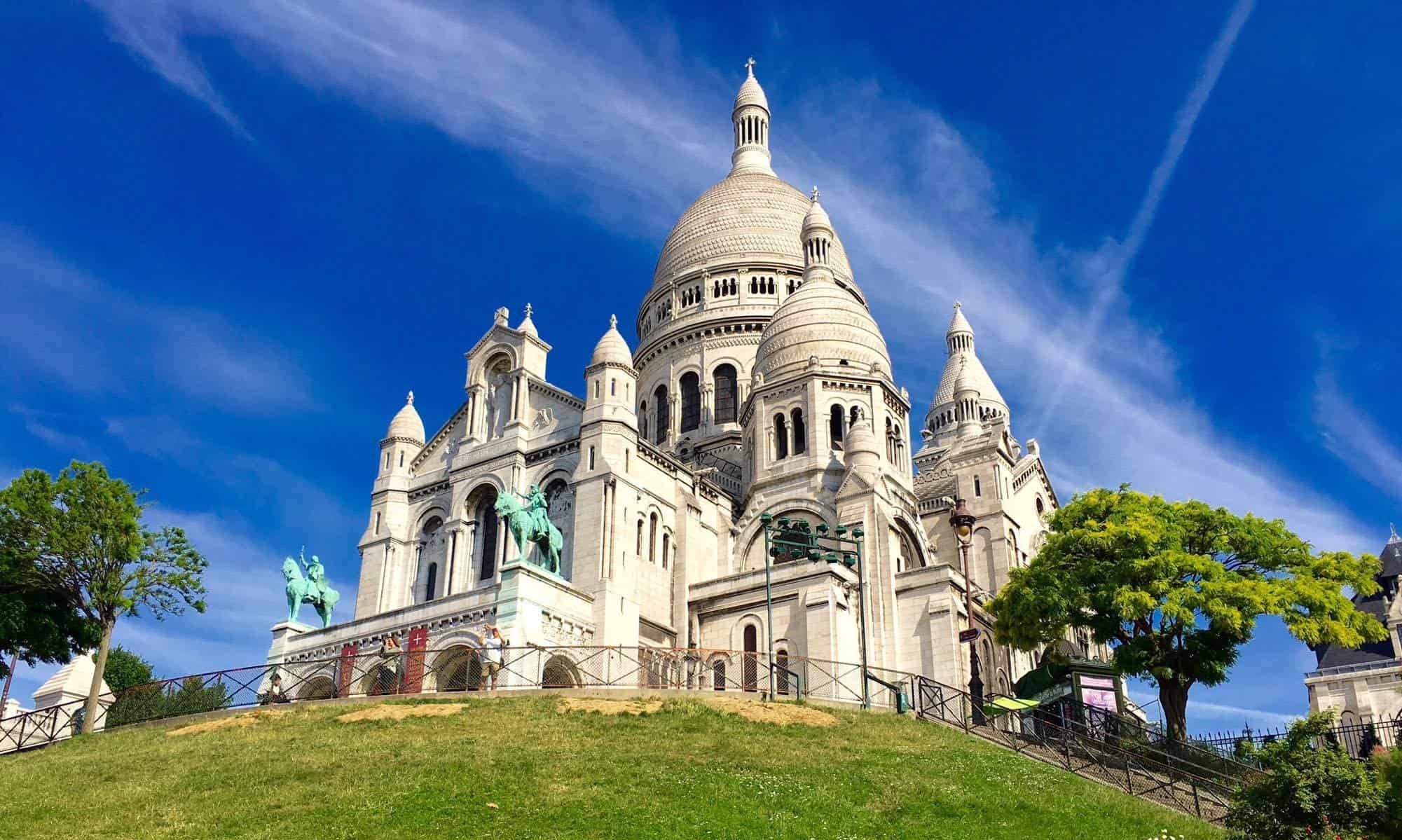
This past weekend, we had the opportunity to watch the men’s and women’s Olympic long distance cycling events, involving 80-90 riders. After multiple hours, these races took them from outside of Paris back into the city. The telecasts of the races highlighted the latter segments, which included the challenging ascents to Montmartre, as the participants sped their way through and past the large crowds gathered on the hillside surrounding the church of Sacre Coeur. As they did, race commentators noted that the church is said to be Paris’s second-most visited tourist site after the Eiffel Tower.

With its soaring lines and its location on one of the tallest elevations in Paris, along with its stone surfaces, Sacre Coeur may remind us of some medieval European cathedrals. Despite its historic appearance it is a relatively modern building. Construction began in 1875, and concluded in 1914. What first strikes many viewers is the building’s structural emphasis upon height, reminiscent of Gothic predecessors, which is accentuated by its notably elongated or stretched rather than hemispherical domes (as is evident in the drawing above).
What is unique about this building is its homage to the Greek Cross plan, including its Romanesque arches. These features recall the general design of Constantinople’s great church, Hagia Sophia, and the common pattern for Islamic mosque architecture subsequently derived from it. Sacre Coeur’s Greek Cross plan is also reminiscent of Venice’s medieval basilica of San Marco. Roughly contemporary with Sacre Coeur, is H.H. Richardson’s evocative Trinity Church in Boston (1872). Like Trinity Church, Sacre Coeur’s design has been described as neo-Byzantine (as well as Romanesque), and the label fits specifically in connection with the historical precedents of Christian and Islamic origin just mentioned. Sacre Coeur’s design-dependence upon this history is most evident by studying the drawing provided below.

The above rendering of the floor plan of Sacre Coeur is vital for appreciating how this church building is as characteristic of the Christian East as it is of the West. The key point to observe involves the inner four columns that support the large central dome, and the four smaller domes on the peripheral corners that encompass the central square. These smaller domes as well as the huge principal one are suggested in the floor plan by the patterns of concentric circles adjacent to the four columns.
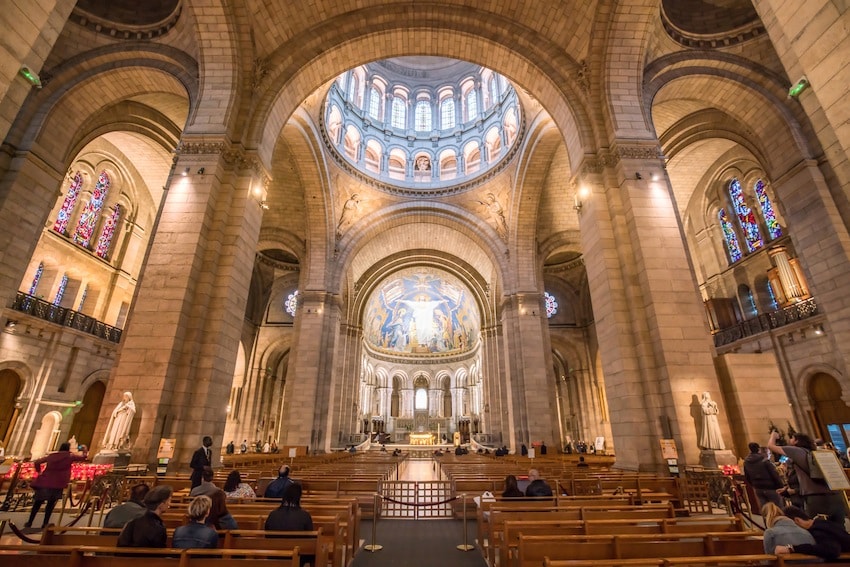
Between the domed spaces we find four rectangular areas of space that parallel one another in size, forming the arms of the Greek Cross. Like mosques geographically oriented along an axis directed toward Mecca, Christian churches traditionally are oriented with the altar on the eastern or sunrise side of the building, in honor of the Resurrection. Yet, due to the chosen site for a new church, the structure might have its chancel and altar on the north side of the building, as is the case with Sacre Coeur.
The apse, or altar area of Sacre Coeur is indicated in the above drawing by the Latin cross-shaped floor pattern. It is mirrored in length by the entrance portico, shown in the lower portion of the drawing. The semi-circular chapels surrounding the apse and its altar reflect an homage to Western and Latin medieval Gothic precedents. In Western, Gothic-inspired church architecture, the placement of these chapels is thought to represent the thorn of crowns placed on Christ’s head.
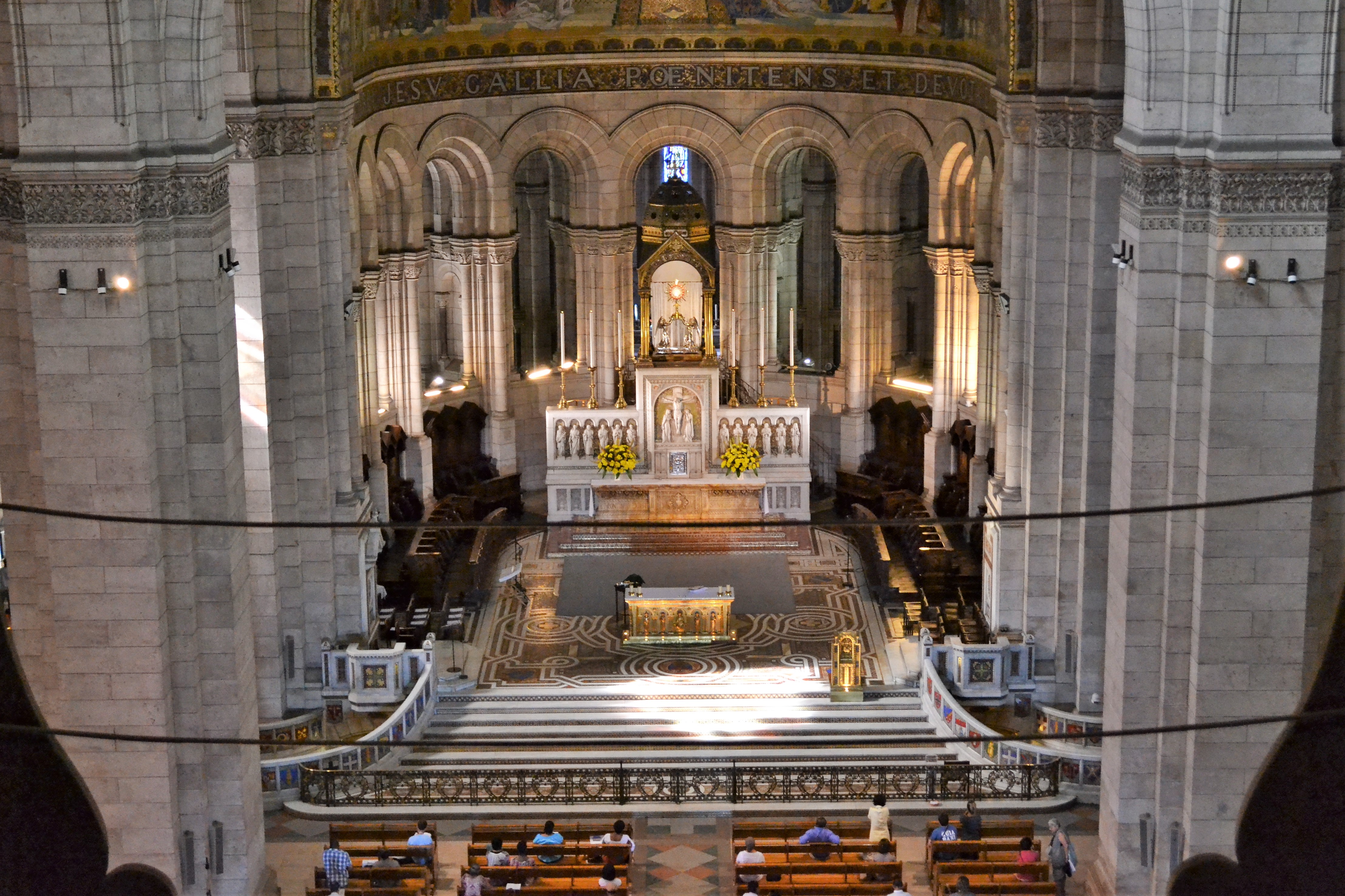
The choir or chancel at the liturgical ‘east’ side of the church
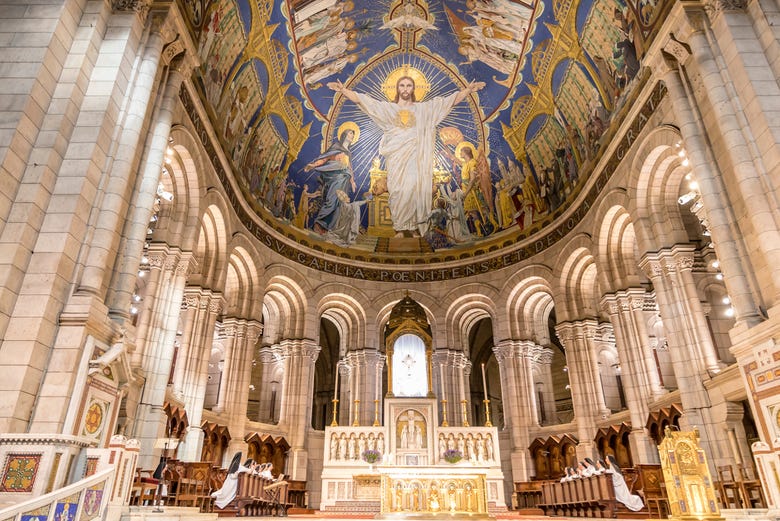
The remarkable ceiling mosaic over the choir
Another distinctively ‘Eastern’ feature of this building is its adornment with mosaics, and principally by the vast mosaic covering the ceiling over the chancel and choir, above the main altar. Designed by the noted painter, Luc-Olivier Merson, whose Annunciation painting I have previously featured, the mosaic is composed of some 25,000 ceramic tiles, many of which are gilded. With this church dedicated to the Sacred Heart of Jesus, it is not surprising to see the Lord depicted with outstretched arms and the golden namesake of the building emblazoned on his chest. Yet, even with this distinctively Western motif, the mosaic recalls the frequent choice in the East to portray Christ the Pantocrator, or the Almighty, in a mosaic or painting on the surface of a principal dome or semi-dome in a church.
I admit to this. Sacre Coeur in Paris has in the past looked to me like a Disney park caricature of a grand, historically classic, stone church. Having studied the plan and its design with more attention, as well as learning more about the original architect and about many of its details, I have a heightened appreciation for this remarkable and liturgically conducive building.

 Toward Beauty
While we have watched a good number of Olympic events, I am sorry to say we did not watch the Olympic cycling events, so we missed seeing this wonderful house of worship. Thanks for this piece, with all of the information about the church. Bruce
Thanks: NBC and the Peacock networks have extensive online links to view, and replay, all (it seems) Olympic events. I saw the men’s race; but viewed portions of the women’s race on replay. In both cases, Sacre Coeur was warmly noted.