[If reading this by email, please tap the title at the top to open your browser for the best experience. Then, clicking individual pictures will reveal higher resolution images.]

I discovered M. Wylie Blanchet’s cruising memoir, The Curve of Time, at Village Books in Fairhaven, Washington, not far from the Canadian border. Evidently considered a classic by readers in Canada, I had not known about her book despite having long been an active boater and avid reader about seafaring. With an evocative water color painting as a cover image, a forward by the Seattle-based writer Timothy Egan, and with the copy in my hand being the 50th Anniversary Edition in hard cover, I was intrigued and bought it.
As the dust jacket blurb indicates, Wylie Blanchet set off on numerous summer cruises with her five children on the same boat from which her husband had earlier been lost in 1926, and presumed to have drowned. 25 feet in length, 6.5 feet in width, and with a relatively small enclosed interior, Blanchet along with her children bravely explored the sometimes forbidding but always mysterious waters along the coast of British Columbia and its adjoining and deep inland sea.
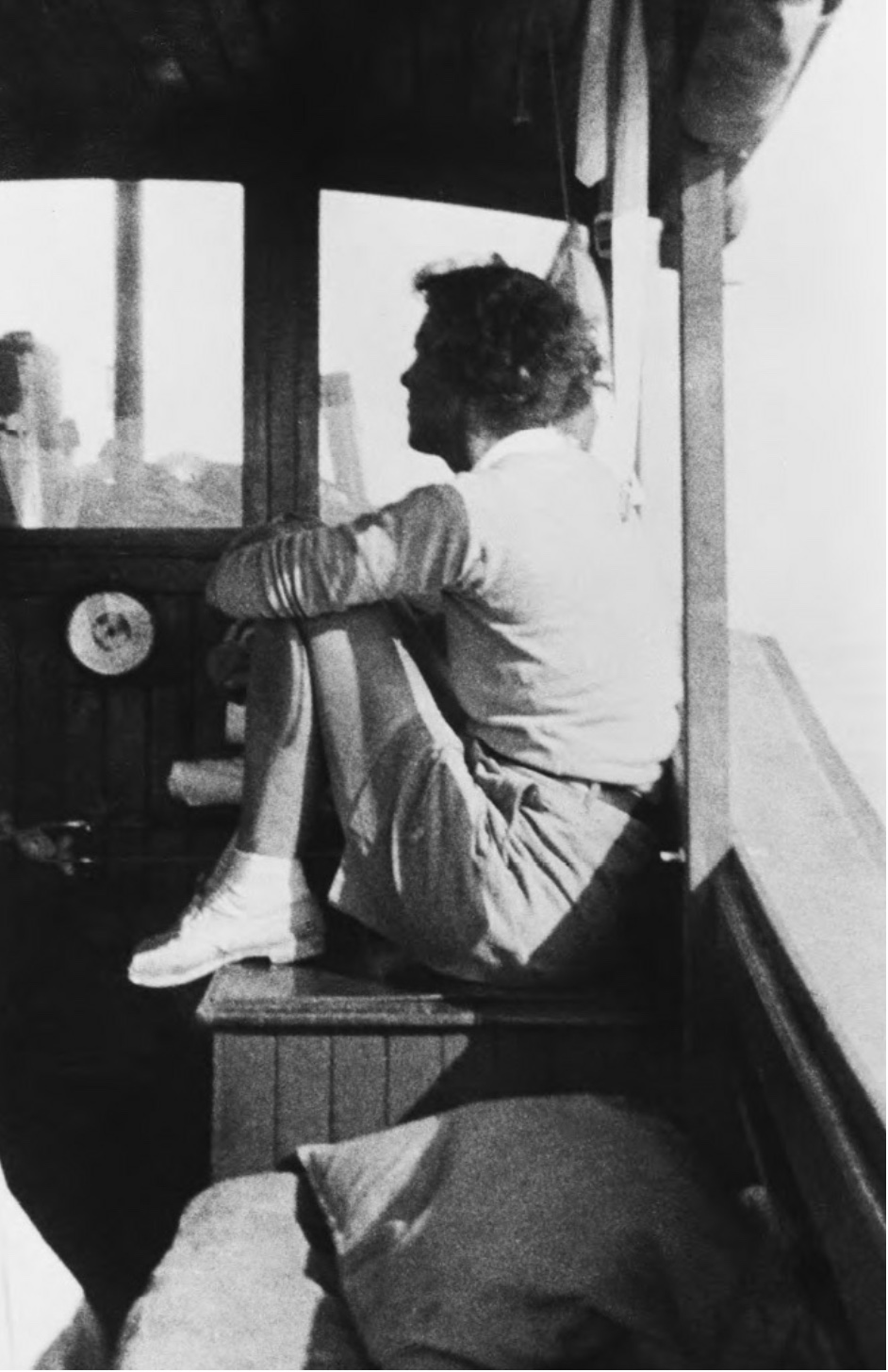

Wylie (a.k.a., Capi) in the wheelhouse of Caprice, and with her family one summer
Those British Columbia waters are famous for the very strong tides running in and out of narrow fiord-like inlets bordered by tall trees and sheer rocky walls that rise up several thousand feet. The walls above the water’s surface are generally paralleled far down below by their unseen foundations. ‘Capi’ Blanchet notes how often her marine charts indicated depths exceeding 100 fathoms in these waters (600 feet), with the final distance downward marked as unknown. Among other challenges, such depths make anchoring nearly impossible except when a boat is secured to the shore.


Caprice, against a rocky shoreline
With one set of clothes per family member along with a bathing suit, spare but adequate cooking equipment and tableware, minimal sleeping accommodations both within and on deck, and the crew possessing a seemingly boundless sense of curiosity and desire to learn, the Blanchet’s explored hundreds of miles of what at the time were largely unpopulated and untamed seascapes and surrounding terrain. Capi Blanchet’s well-told stories about her family’s adventures during their summer cruises provide the material for her fetching book.
For those who have traveled to or lived in the Pacific Northwest, the author’s prose brings alive the look and feel, and even the smell of the moist coastal air found in that region. It may bring to mind books like I Heard the Owl Call My Name, and Snow Falling on Cedars, novels that also effectively describe aspects of that alluring part of the world. Yet, like those others, Blanchet’s book hardly prompts a romantic longing to explore waters and lands that, as she presents them, are full of potential danger because of their wildness (bears, a cougar) and unpredictable weather.

Readers interested in doing some ‘voyaging’ with Capi Blanchet through reading A Curve in Time will observe how she records experiences from the late 1920’s and 1930’s, and published her memories of them in 1961. She demonstrates sensitivity and concern about our encroachment upon the communities of people who originally inhabited the land, and upon areas of great natural beauty. Her perspective and writing may perhaps best be seen as helping – along with many others – to lay an early foundation for our contemporary approach to ‘the environment’ (a term whose present use would have been unfamiliar to her), and our raised sensitivity about the cultures of First Nations peoples.
Having read Blanchet’s compelling book, I am now curious to read Following the Curve of Time: The Legendary M. Wylie Blanchet, a biography by Cathy Converse. Though often demurring from drawing attention to herself in The Curve of Time, Blanchet clearly was a formidable woman possessed of great practical intelligence and a captivating sense of adventure. Retracing her voyaging would be challenging enough for many experienced boaters, but exploring those same waters in a boat the size of her’s, with its dependent large crew and minimal accoutrements, may suggest caution to other equally capable navigators.


M. Wylie (‘Capi’) Blanchet around the time of her marriage
For first time visitors to the Seattle area who are not embarking upon an Alaskan cruise, I heartily recommend even a short round trip on one of the Washington State Ferries. Having commuted daily to college for a year on the ferry between Vashon Island and Tacoma, and having regularly taken the ferry to Seattle on weekends, I remember how a 20-30 minute ‘voyage’ across parts of Puget Sound can help one experience in an economical and time-sensitive way a genuine bit of the maritime Pacific Northwest – the kind of waters that Capi Blanchet explored nearly 100 years ago.
 Toward Beauty