[If reading this by email, please tap the title at the top to open your browser for the best experience. Then, clicking individual pictures will reveal higher resolution images.]

On a recent trip to Seattle I visited the Chihuly Garden & Glass exhibit at Seattle Center. This collection of Dale Chihuly’s glass work, which includes both large and small objects and installations, provides a splendid way to become familiar with what the artist has accomplished so far over the course of his career. The extensive exhibit gives the visitor an excellent introduction to the methods that Chihuly has employed when embarking upon various projects and insight about how he has revolutionized many aspects of contemporary glass making.
An initial large room contains a display of smaller Chihuly creations set within the context of a selection of his baskets and related objects from First Nations peoples, as well as an assemblage of his large framed photographic prints of Native American individuals by Edward Curtis.


A large gallery within the exhibit features Chihuly’s Mille Fiori (a thousand flowers in Italian), inspired by memories of his mother’s garden. An information panel indicates that the pieces in this installation, gathered from several series of his prior work, “rely less on tools and more on the use of fire, gravity and centrifugal force.”
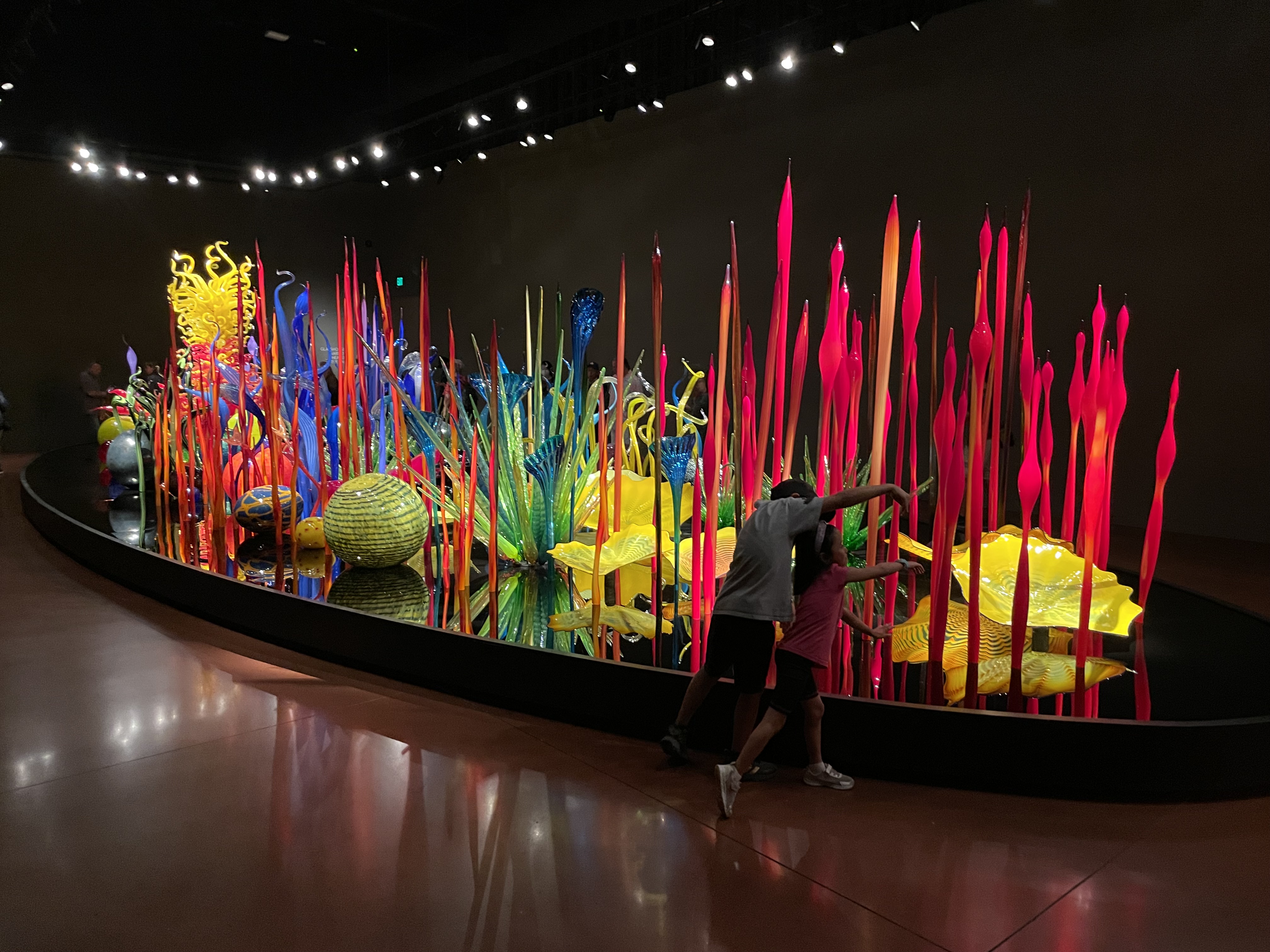
Two youngsters enjoying engagement with Mille Fiori while helping to provide us with an indication of the assemblage’s scale.
A display titled Ikebana and Float Boats is featured in a subsequent room. Having pursued glass making in Seattle and in Venice, both near significant bodies of water, Chihuly experimented with glass objects thrown into a river in Finland, where youth from the area in wooden boats helped retrieve them. Intrigued by the interaction between the objects, the light above, and the water below, the artist continued to develop these interests after traveling to the Japanese island of Niijima. There he became reacquainted with the glass globes traditionally employed by Japanese fishermen as floats for their nets, which he had first seen as a youth beach combing on Puget Sound. At the same time, Chihuly was inspired by the Japanese art of flower arranging, called Ikebana. He combined his interest in the glass globes with the inspiration provided by Ikebana and imaginatively adapted these forms within boat-shaped structures that have been displayed in galleries and upon ponds.

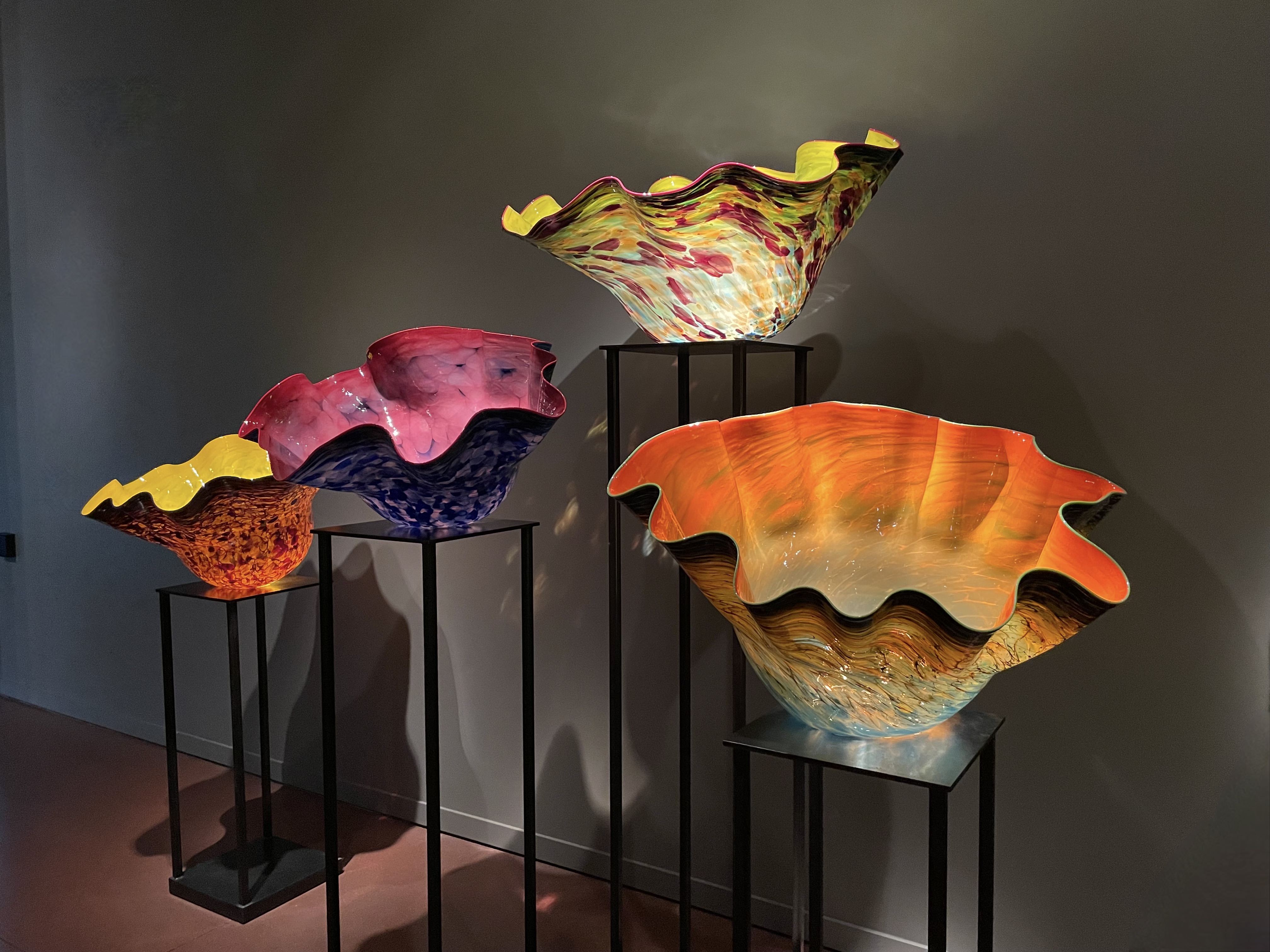
Another gallery space features large bowl-like objects from Chihuly’s Macchia series. As a guide at the Chihuly exhibit makes clear, no one has yet been able to produce a truly black form of glass. Yet, Chihuly has come close with his occasional use of very dark blue and purple. Through his Macchia series, he sought to incorporate every one of the other 300 colors that are available for glass making. Noticing that colors within stained glass windows often appear more alive when illuminated from behind by the diffused light of a bright cloudy sky, Chihuly began to experiment with including a white layer within objects between the inner and outer colored layers of glass. The presence of speckles and striations of additional colors results from when molten glass is rolled on a flat metal surface that has been sprinkled with multiple-colored bits of glass.

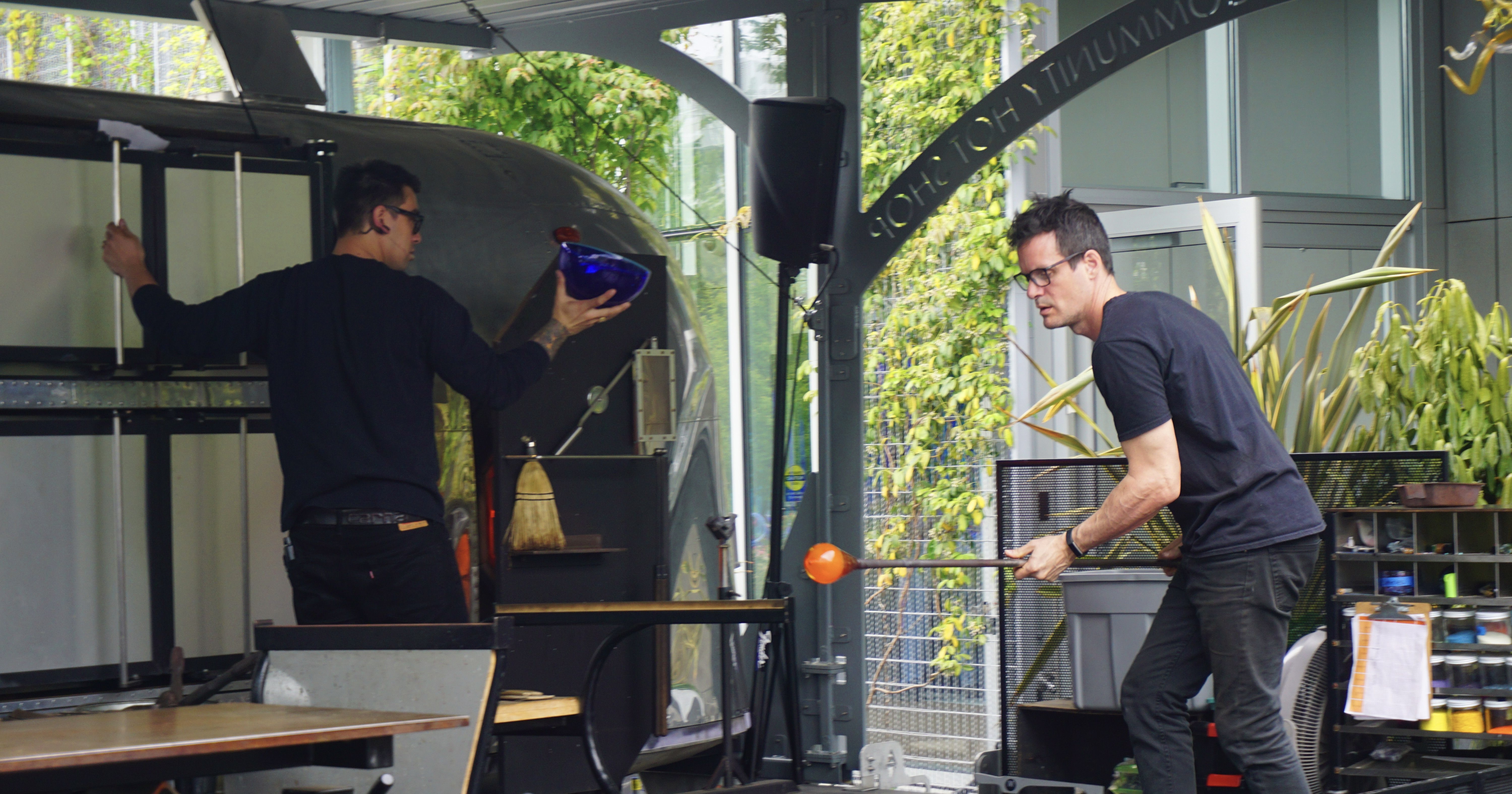
Near the end of a tour through the exhibit one finds a courtyard where an informative glassblowing demonstration is offered, which brings alive some of the challenges inherent in working with this medium.
Chihuly Garden & Glass provides a lively sense of the remarkable extent of the artist’s output, and the breadth of his highly imaginative vision for what can be done with glass as an art form. The exhibit is well worth a visit for those able to travel to the Seattle area.
 Toward Beauty