
Among the charms of Wales are the narrow gauge railways that meander up from the coast through the verdant dales that lie between often steep mountainsides. Several of these lines were first established as early as the mid-nineteenth century as simple and utilitarian slate delivery railways. Ongoing preservation efforts related to them have attracted increasing attention, in part because their histories are interconnected with the economic and social circumstances of many small Welsh communities and their rural surroundings.

At about nine miles in length, the Talyllyn provides an attractive example of a Welsh narrow gauge railway. Its small scale is endearing. And so is the story of Tom Rolt and his fellow volunteers’ remarkable efforts to keep this venerable line running when, in 1951, its demise seemed certain. Their work of founding and then sustaining the Talyllyn Railway Preservation Society is told in a book by Rolt, first published in 1953, and still in print.

Through Rolt and his team’s efforts, the Talyllyn became the world’s first heritage railway and a viable commercial enterprise. Like several other Welsh narrow gauge railways, the Talyllyn had its origin as a means of transporting slate from upland quarries down to seaside piers or transfer to larger rail lines. Some of these narrow gauge railways first used horses to pull the empty ’wagons’ up to the quarries, while slate cutters rode the heavy wagons filled with slate roof shingles on the downhill run, relying upon handbrakes alone for a safe journey! The first steam locomotives arrived on the Talyllyn upon receipt of the railway’s charter by an Act of Parliament in 1865, and two of them are still running.

Among the social impacts of the Second World War upon the lives of those in the United Kingdom was a contemporaneous rise in the mobility of many citizens for the purposes of work and leisure, while changes in historic industries like slate mining were negatively impacted by foreign competition. At a time when slate quarries such as the one served by the Talyllyn were waning in production, increased opportunities for tourism, especially for workers from urban industrial areas, gave new life and purpose for several historic Welsh narrow gauge railways by providing access to holiday destinations. The Golgoch Viaduct illustrates an aspect of this transition from the railway’s utilitarian origins to its present role in providing memorable recreation experiences. The viaduct remains a beautiful example of Victorian engineering whose original purpose was simply to serve as a means of allowing relatively level access to a slate quarry, and which over time has become a noted tourist destination itself.

Standard gauge railroads in America and in Britain have a space of four feet and eight and a half inches between the rails. By contrast, the Talyllyn has a gauge (or gap between the rails) of two foot, three inches. Though narrow gauge train carriages must therefore be built more narrowly in contrast to those operating on standard gauge track, the smaller Welsh trains can travel on lighter rails, laid on narrower roadbeds with tighter curves, making these railways more practical for their original purpose of serving mountain quarries.
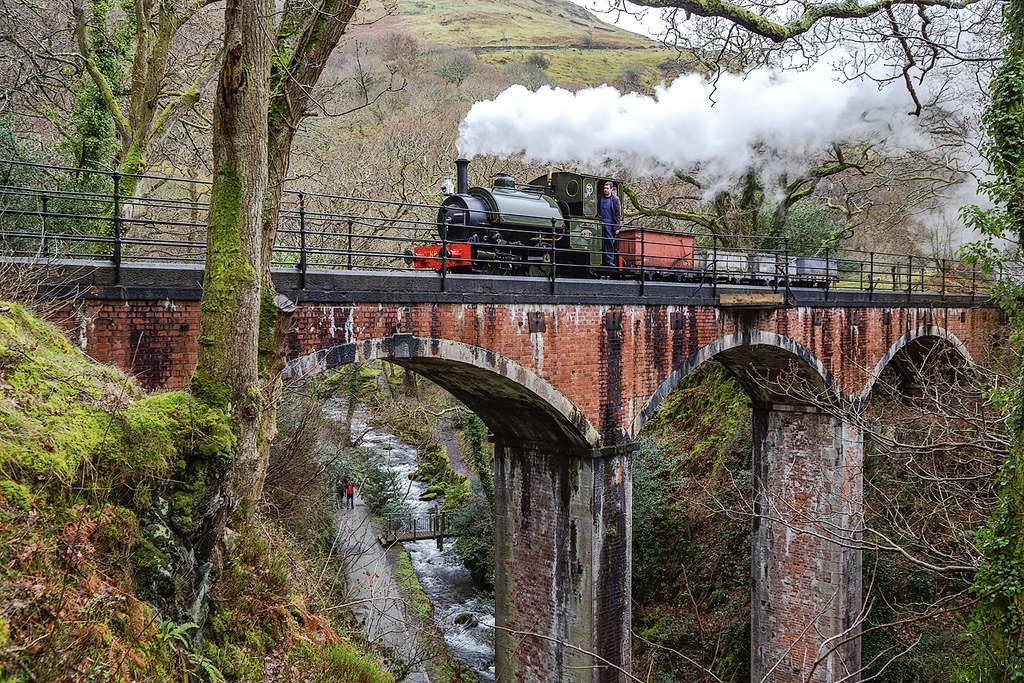
Several videos showing the run from Tywyn Wharf to Abergynolwyn can be found on YouTube (links below), two of which are filmed from the viewpoint of the engineer in the locomotive’s cab. Though the length of the Talyllyn is just under ten miles, the journey with stops takes upwards of 45 minutes. Yet, given the beautiful Welsh mountains and valleys, and the train’s relatively slow movement, the route of this historic railway seems much longer. I hope someday to enjoy a ride up and down this historic and scenic route.

For those who would enjoy an engineer’s view of a journey on the Talyllyn, I commend the following two videos: “Talyllyn Railway – a cab ride on Loco No.3 from Wharf to Nant Gwernol” (https://youtu.be/pOnMFEdcBb4?si=OEjaoG5nplND0JC_), and “‘Dolgoch’ takes us for a Full Line Trip on the Talyllyn Railway” (https://youtu.be/iMjUxDpYcUk?si=Kr6-WAwIeePWdYN0). After viewing these, you will want to join the many others who make pilgrimages to this venerable railway ‘shrine’!
 Toward Beauty
This was fascinating. Thanks, Stephen.