If reading this by email, please tap the title at the top to open your browser for the best experience. Then, clicking individual pictures will reveal higher resolution images.

A city and its cathedral, San Marco, are built upon low-lying islands and saltwater marshes. From its earliest history, Venice has contended with the sea. But in recent times, the municipality and its basilica have continued to suffer from sinking land and high waters, much to the grief of those who love this historic place. This emerging geographical tragedy is of world-wide significance, and begs for sensitive and imaginative responses. I can only offer a personal spiritual witness.
For it is one of the most beautiful places I have visited, and one that has played a significant role in my spiritual journey. Formally, the building is the Patriarchal Cathedral of San Marco, in Venice, and is named for the Gospel writer, Mark, whose remains are believed to be entombed in the structure.
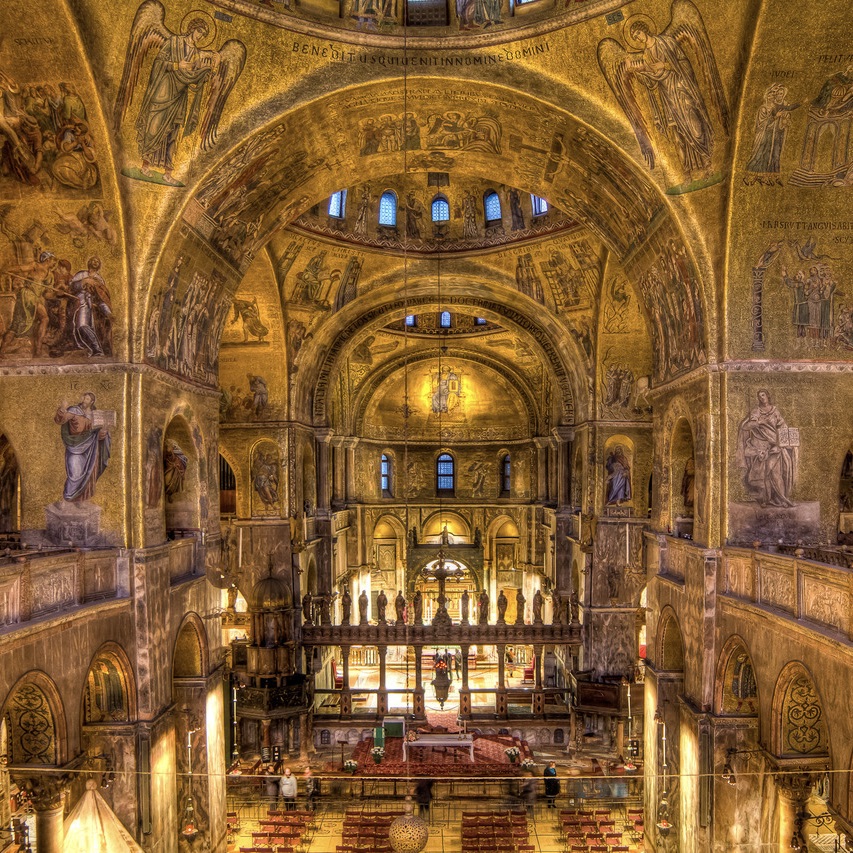
In the autumn of the year when I experienced adult conversion to the Christian faith, as a college exchange student in Europe in 1976, I found myself pulled. Pulled forward, toward an unappreciated and an intellectually misunderstood faith, and pulled away from having been a largely agnostic art major. By God’s grace, two buildings played a significant role in my spiritual journey.
The first was the basilica or shrine commemorating St Francis, in Assisi, with its incredible Giotto frescoes. The second, and for me the more enduringly influential, was St. Mark’s in Venice. It was an unexpected but important precursor to what I experienced recently at Hagia Sophia in Istanbul. For what strikes many visitors is how much San Marco owes to the architectural heritage of the Christian East, even though we also see how aspects of it are congruent with earlier buildings found in the West.
While growing up in Japan, with my family I visited Buddhist temples and Shinto shrines, many of which seemed to be genuinely holy places. I believe these experiences helped to prepare me for what happened when I walked into San Marco on a Sunday morning for the Eucharist. I found it breathtaking. For it was and is a place that draws people in, not only to marvel at its beauty, but a place that seems historically and organically to be imbued with a reverent sense of devotion to what is transcendent, to what is other. On my first visit there, I could see that I was not alone in this perception, especially as I experienced being present for worship in that transformational interior. As T.S. Eliot said about another church, San Marco is a place “where prayer has been valid.”

Notice, above, the elongated or stretched domes as we find in the much later Sacre Coeur, Paris (recently featured here)
There are reasonable grounds for supposing that the actual remains/relics of St. Mark were brought to Venice around 830 A.D., and that the earliest form of the basilica was then built to house them, completed by about 836 A.D. This was at a time when the Republic of Venice began to emerge as a regional power in the Byzantine continuation of the Roman Empire. One observable reflection of Western influence upon this very Eastern-looking building can be seen in the foreshortened dimensions of the chancel or sanctuary space. This space contains the altar, surrounded by a semi-circular apse, in the liturgically eastern arm of the Greek Cross plan (at the top of the diagram shown below).
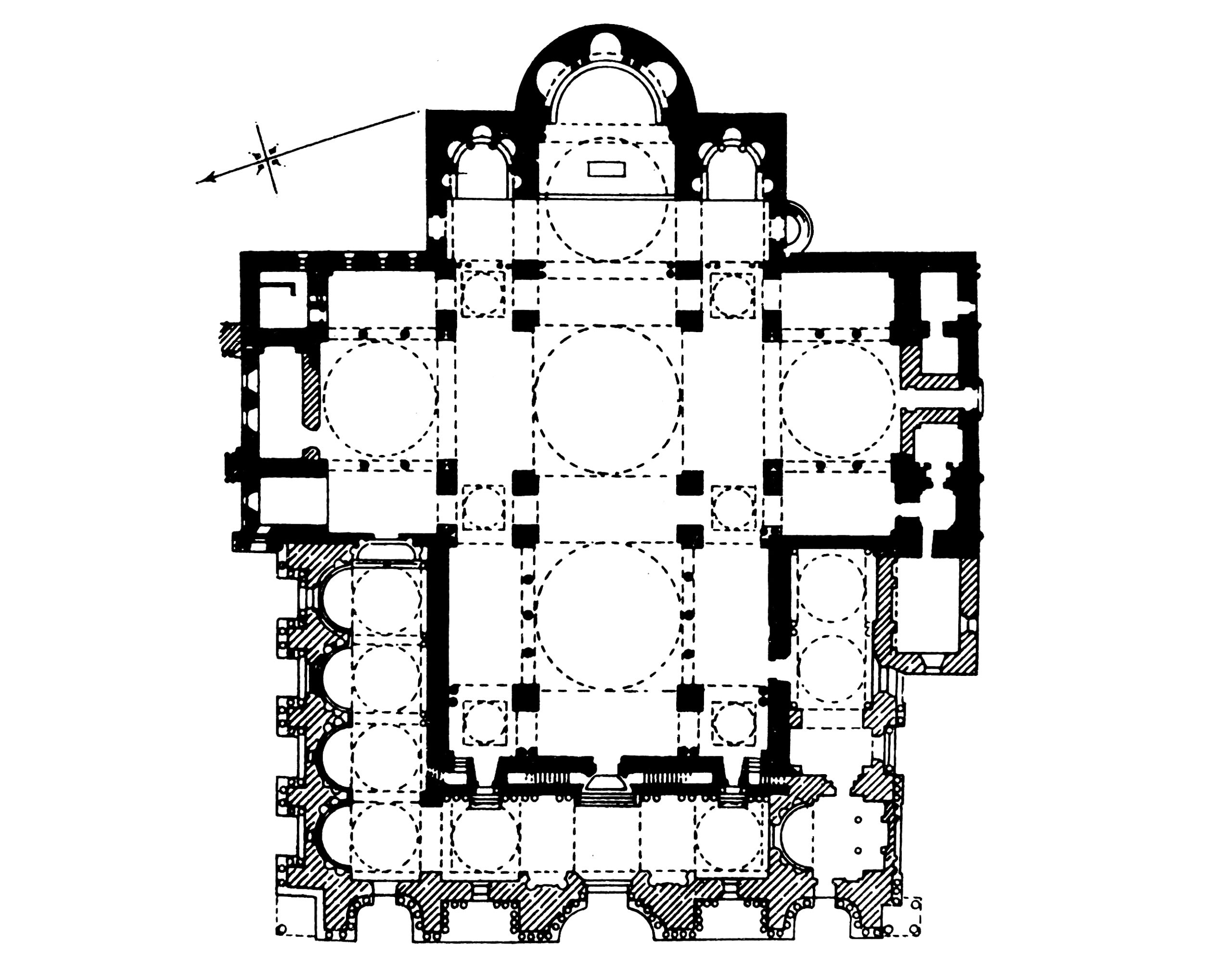
Floor plan of San Marco, showing the Greek Cross pattern with five domes
In the Christian West, we have – at least since the Englightenment – been inclined to see the heart of Christianity as expressed in doctrinal terms, and doctrine as conceived primarily in a propositional way. In my acquaintance with Eastern Christianity, I have found a predominant disposition towards mystical theology and the spiritual life. A personal fact connected with what I have shared above, is this: after camping and fasting for about 5 weeks on Crete between Oxford terms during that same exchange-study year, I was baptized at the Easter Vigil, in St. Paul’s Anglican Church, in Athens, Greece. It was on March 25 (a significant Marian date), 1977, in a place that is a gateway to the Christian East.
I have long had a devotion to St. Mark, stemming from my experience in this beautiful cathedral building dedicated to him in Venice. I was ordained on St Mark’s day forty years ago, and was later called to serve as Assistant Chaplain of Keble College, Oxford, while pursuing my doctoral studies. These experiences gave me a heightened sense of God’s mysterious Providence in bringing together unexpectedly connected threads in my personal history. For blessed John Keble, in whose memory my Oxford college was founded, was himself devoted to St. Mark, having been born on St. Mark’s day, a day which was then chosen for the foundation and eventual dedication of the college.
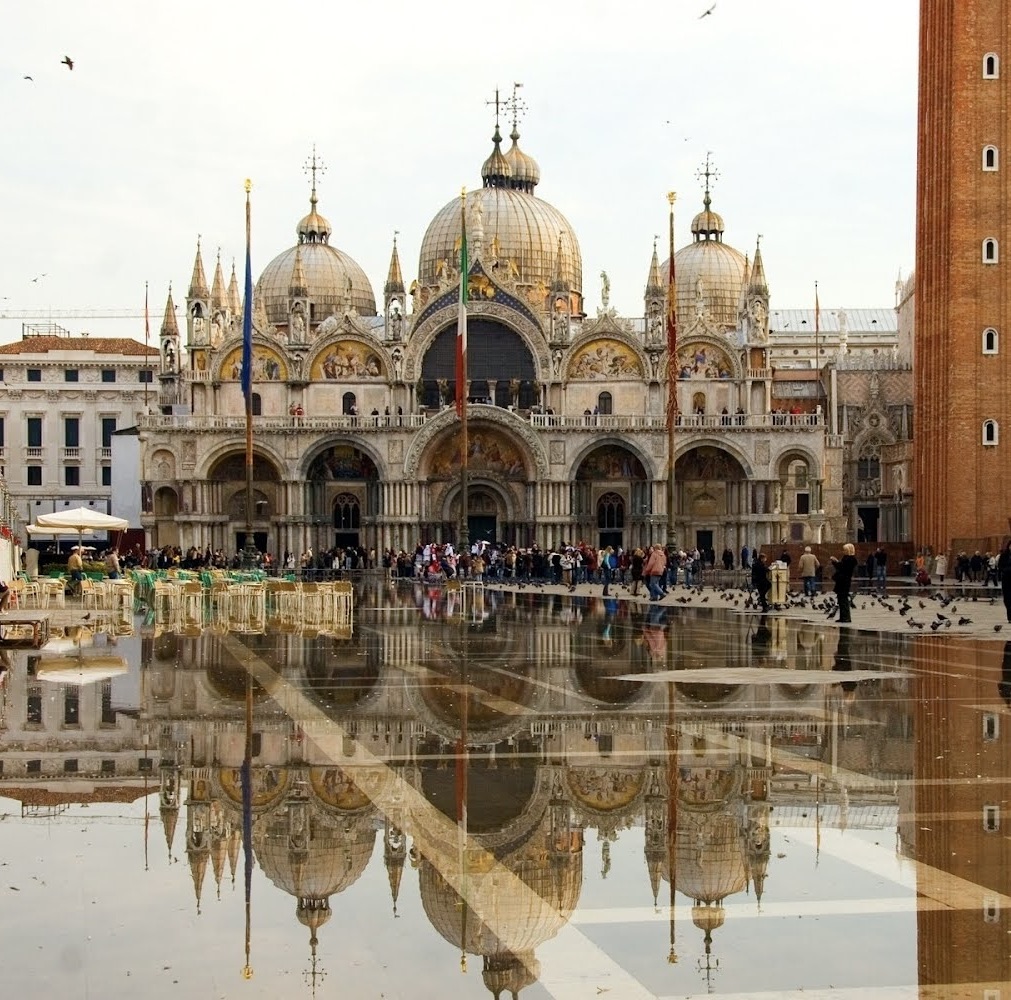
San Marco and its public square, as – sadly – it more frequently appears. When I returned to Venice and San Marco in the early 2000’s, I was dismayed by how much the tiled floor of the basilica evidenced significant warps in its surface, principally from water intrusion.
 Toward Beauty
Kathryn and I visited with our son’s family some years ago. We found the Cathedral both beautiful and spiritually impactful as are many of the worship spaces that we have visited. That feeling of “Holy Ground” bubbles up in many places from the magnificent structures to the most simple spaces and for me is usually connected to the people who are in those spaces. Venice is one of our most favorite places. There was an older women on one of the water taxies, who looked like she could have been from biblical times. I have to dig up that photo. Thanks again.
I worshipped there this past Easter…. Barbara Allison-Bryan ( from GBEC days)
Thank you for sharing this!