[If reading this by email, please tap the title at the top to open your browser for the best experience. Then, clicking individual pictures will reveal higher resolution images.
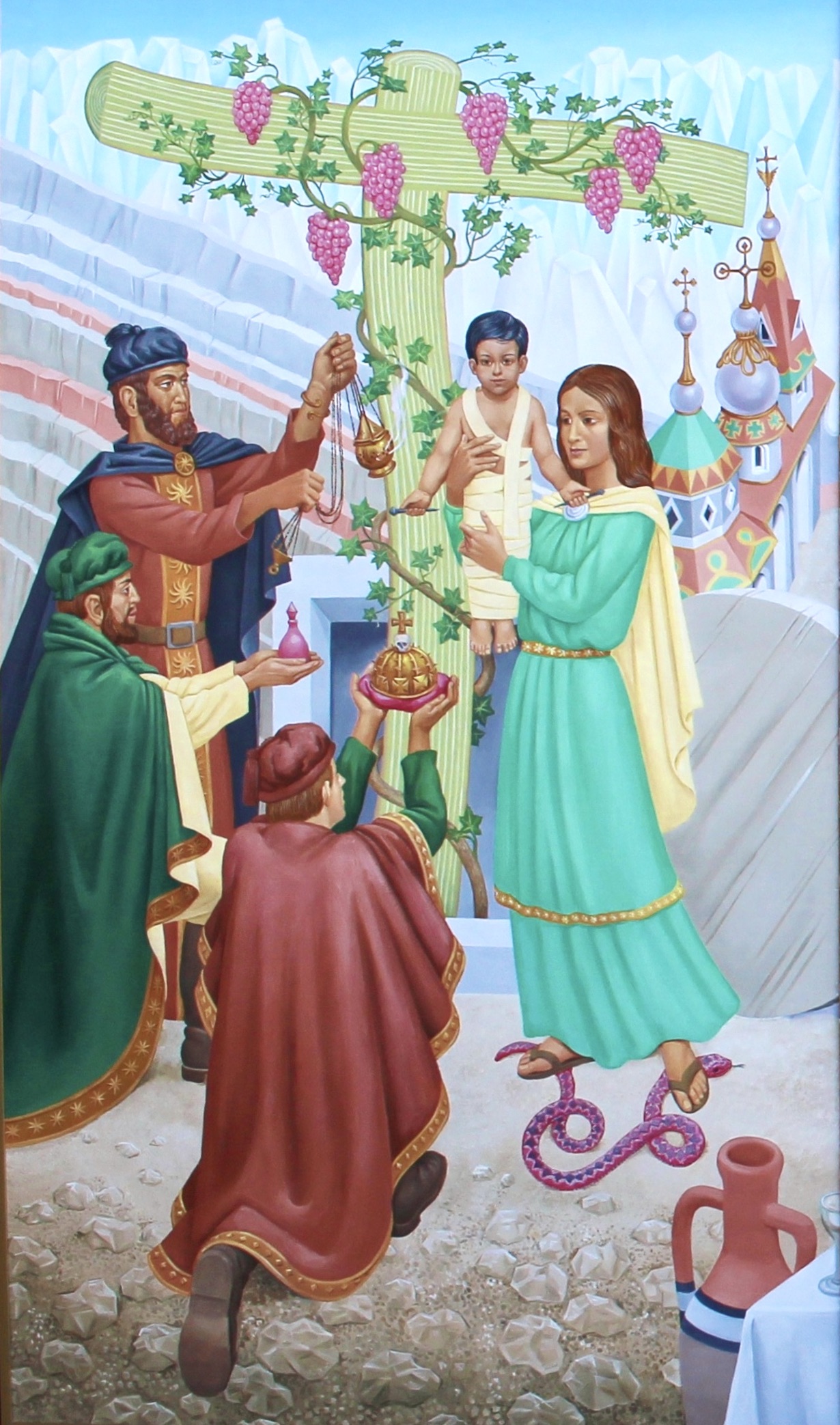
Peter Koenig, Christmas Triptych, Panel 1
Last week I observed how frequently Nativity-themed paintings contain noticeable suggestions of Jesus’ yet to be revealed saving Passion. Sometimes in rather subtle ways, we find in many such works palm fronds, passion flowers, cross-shaped patterns, and even lilies. A window by a Jewish painter, Marc Chagall, and a Christmas card by a Japanese pint maker, Sadao Watanabe, provide two interesting reference points. Peter Koenig, a contemporary British painter, presents a larger sweep of salvation history in his mystical composition, Christmas Triptych. Because of it synthesis of biblical images keyed to liturgical commemorations observed by the Western Church this week, I am pleased once again to share his visionary painting. (The three main panels of the triptych are displayed below.)
In Koenig’s Triptych, we see the Holy Mother and Child, the visit of the Magi (Jan. 6), the martyrdom of Stephen (Dec. 26), the Baptism of Christ and his first miracle at Cana (first Sunday after the Epiphany), as well as the marriage of the Lamb and the New Jerusalem (advent themes from Revelation 19).

Set amidst this larger backdrop are the images within the first panel, portraying the infant Jesus held by his mother. The child appears older than the baby we are accustomed to seeing in traditional Nativity paintings. Yet, this may be historically accurate and a fair representation of what Matthew suggests regarding the Magi’s undated visit. For though Matthew tells us of Jesus’ birth in a stable at Bethlehem, the Magi’s subsequent visit finds the child in ‘a house.’ Their success in finding the one to whom the star has led them triggers Herod’s plan to kill all the male children in Bethlehem “and in all that region who were two years old or under, according to the time that he [Herod] had ascertained from the wise men.”
The child is worshipped by the visitors from the East, a remarkable fact reported by Matthew, and is portrayed by Koenig in swaddling clothes that suggest the strips of fabric from his later burial linens. And he holds large spike-like nails in his hands. The distant-in-time ‘daughter of Eve’ stands on the head of a serpent, thereby fulfilling God’s words regarding it in Genesis 3:14-15.
Also strongly suggestive of the later saving work of this promised child is the large split-wood cross behind the figures, which springs from an empty tomb. Its form and adornment suggests the biblical Tree of Life. The cross has a fruited vine entwining it, exemplifying Jesus’s words about the vine and its branches, and evocative of a significant number of Old Testament images. As Christmas and Epiphany worship texts remind us, the three gifts borne by the Magi are symbolic of this child’s transformative meaning for this world in God’s Providence: gold for his royal status; incense for his divinity; and myrrh for what turned out to be his only-temporary burial.

Another painting by Peter Koenig featuring a ‘life-giving tree’ , Tree of Life, Tree of Death
May these 12 Holy Days of Christmas be a time of renewal for us and for His whole Church, in which we rediscover the saving mystery of his birth among us, and what it would foreshadow for our still-needy and suffering world.
 Toward Beauty