[If reading this by email, please tap the title at the top to open your browser for the best experience. Then, clicking individual pictures will reveal higher resolution images.]

Paprika Persian, by Dale Chihuly
Many of us associate glass as a material for art with beautiful stained glass windows, or with fine cut-glass objects. Yet, until the widespread impact of modern art, stained glass has most often been characterized by the two dimensional pictorial representation of biblical or historical figures and events. And decorative glass objects, especially when fashioned from clear leaded glass, have until recent times come largely in the form of functional vessels like vases and decanters.
The career of Dale Chihuly has coincided with a renewed interest in the artistic potential of glass when applied as a medium beyond the parameters associated with everyday objects. It was not until the second half of the twentieth century that many college and university art departments offered courses in and provided studios for work with glass beyond the design and making of windows, as well as for other materials such as fibers (e.g., weaving). This may have been due to a historic assumption that glassblowing and textiles, along with pottery, are best understood as being within the category of ‘crafts’ rather than as fine arts.
For these and other reasons, encountering the fruit of Chihuly’s longterm exploration of glass and its aesthetic possibilities can lead to an experience of stunning discovery. As we have seen regarding the evolution of David Shaner’s ceramics, Chihuly has moved far beyond producing beautiful but also utility-oriented objects, toward what may be more properly termed glass sculpture. Throughout the range of Chihuly’s work with glass we find a number of features that deserve to be noted. These include his appreciation for the capacity of color, form, texture, arrangement of parts, and scale to evoke interest and delight.

Capri Blue Seaform
Seagrass Seaform
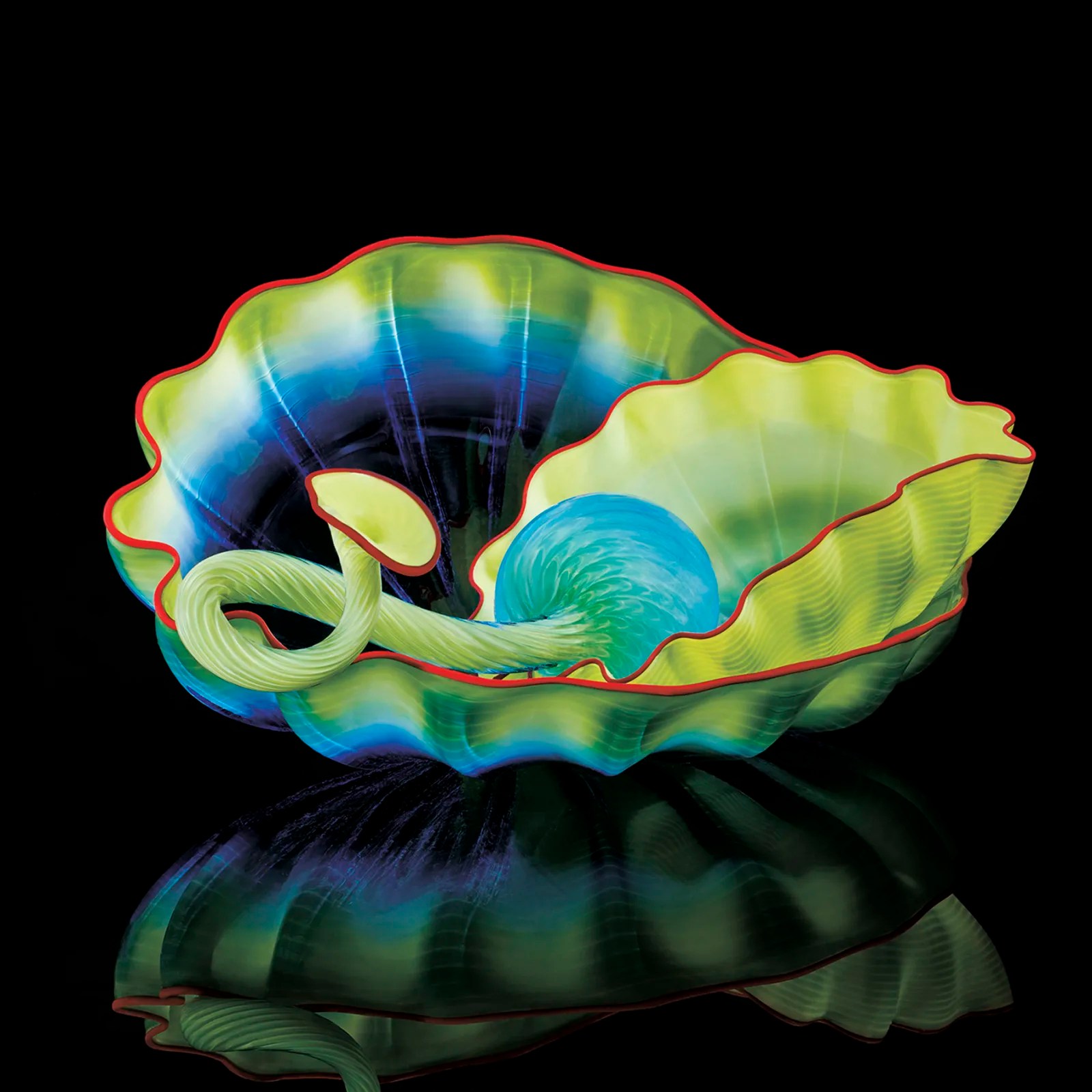
Chihuly’s use of color immediately captures our attention as we view his work. Unlike the challenge faced by those who draw or paint, where choosing and mixing color is a more direct process, color selection and its manipulation within molten glass is more complicated. In glass making, as it is for ceramicists who work with glazes, the artist must attend, at least at a basic level, to some chemistry, the physical plasticity of the material, and be open to chance regarding both.
Another noteworthy feature of Chihuly’s glassware is his intentional inclusion of areas of opacity, translucence, and transparency. With all three of these variables, his manipulation of surface reflectivity – a property often associated with high quality glass – deepens our appreciation for his work. He achieves beautiful effects when he allows these differing aspects of his materials to appear adjacent to one another in the same finished pieces. I find this to be especially apparent in the two pieces depicted immediately below.
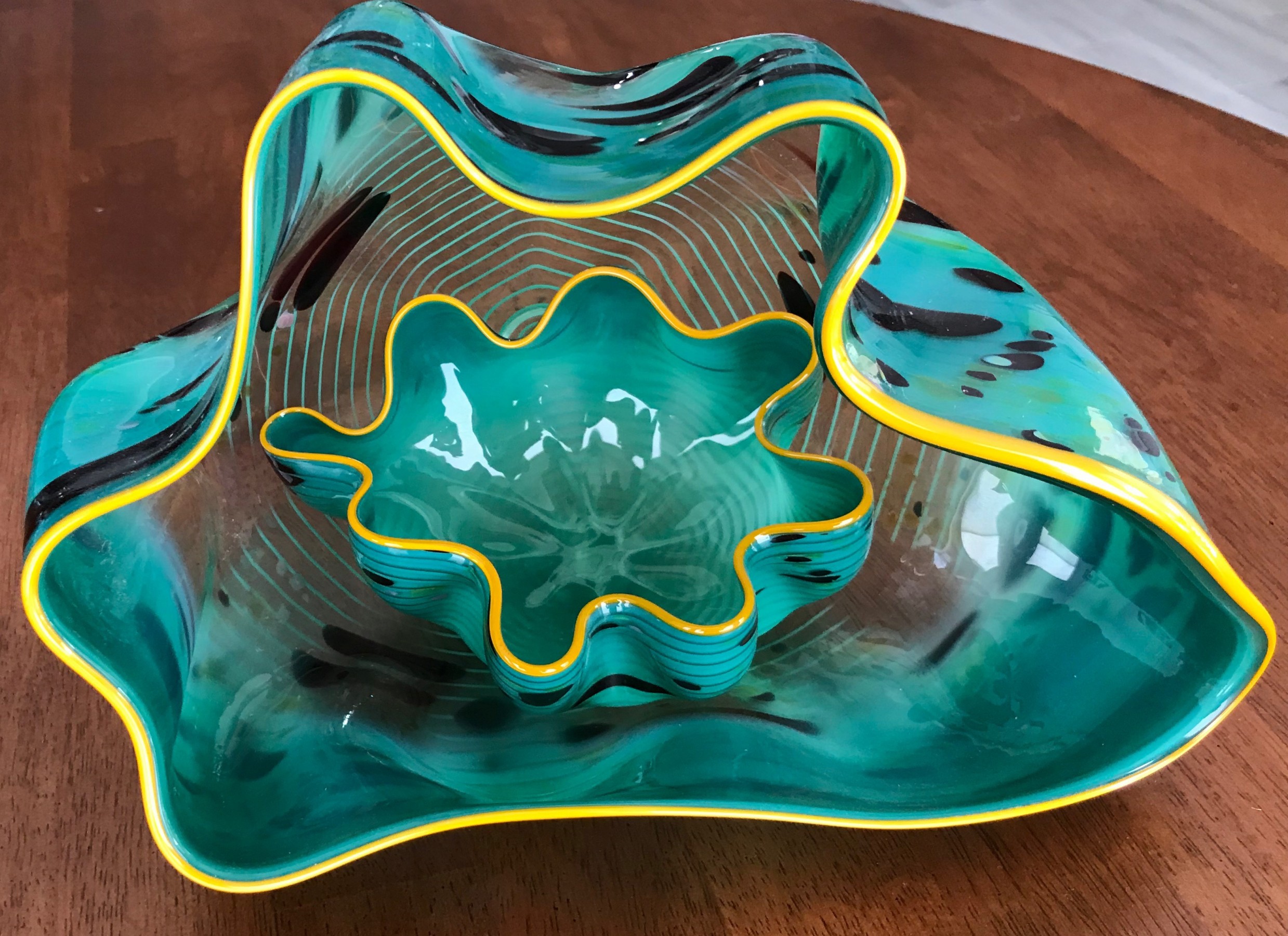

Two sculptural glass works by Dale Chihuly (name and date uncertain)
An additional feature of Chihuly’s mature glass work is the variability of the form and of the shape of the objects he has created. As the artist’s portfolio has expanded with the development of his career, he has moved well beyond the pursuit of symmetry, practical utility, and manageable size, with regard to the items he has fashioned. This is especially true of the large scale installations to be featured in a subsequent post.
Given all this, the name Chihuly has become synonymous with paradigm-shifting glasswork that is vibrant and joyfully attractive.

Dale Chihuly with one of his large glass installations in the background
 Toward Beauty
I saw an exhibition of his work at the Joslyn Art Museam years ago. It is stunning.